
You can ace every safety check on the road and still watch your career skid on one test cup. That’s the tension. One off-duty choice. One surprise screen. One result in the Clearinghouse. If that sounds like where you’re standing, you’re not alone—and you’re not crazy for asking hard questions about Clear Choice Sub Solution.
You want the truth, not hype. You want what actually works, what fails, and what the real risks look like for a CDL under DOT rules. Here’s the plain, unvarnished review—so you can protect your license and your livelihood. Ready to see past the marketing and into what labs actually catch?
Who this guide is for and how we approach Sub Solution
We wrote this for you if you drive for a living or plan to: CDL holders, trainees, and anyone in a safety-sensitive role. You live under federal rules, chain-of-custody collections, and very little slack. We respect that. Our approach is simple: we compare what Clear Choice Sub Solution says it can do against public lab practices and what reviewers say happens in the real world. We’re not teaching anyone how to cheat. We’re showing you the risks so you can make a lawful, career-safe plan.
As a community group, the Worcester County Republican Central Committee cares about steady jobs, responsible choices, and families who rely on them. We support lawful employment and fair information. That’s our lens here.
How to read this: treat brand promises as marketing until they line up with how big labs like Quest Diagnostics and Labcorp actually run validity and integrity checks. We reference widely recognized checks—pH, specific gravity, creatinine, oxidants/biocides, and temperature—because that’s how samples are judged before any drug analysis begins. One last caution up front: in DOT programs, a substitution or “invalid” report can hit the Clearinghouse and sideline you, even if no drug is found. That’s a career-level risk.
What Clear Choice Sub Solution claims to be
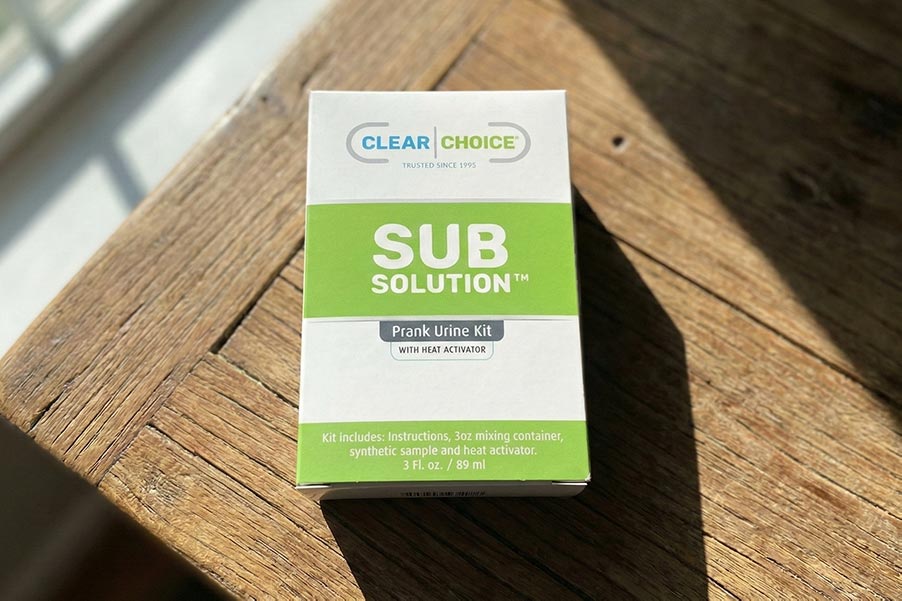
Clear Choice Sub Solution is marketed as a powdered synthetic urine kit designed to mimic human urine for unsupervised urine screens. The company highlights a multi-compound formula—often described as 11–14 components—including urea, uric acid, creatinine, and salts, balanced to fit typical human pH and specific gravity ranges. They also promote a “biocide-free” formula, meant to avoid a preservative marker some labs screen for.
The signature feature is the Clear Choice Sub Solution heat activator (also called heating powder). This additive is supposed to bring the sample into the 94–100°F range quickly, aiming to land it where collectors usually expect a fresh sample. Typical kit contents listed by sellers include:
- A vial of powdered urine
- A mixing container with a spout cap
- A temperature strip
- Heating powder packets
- Printed instructions
It’s positioned as unisex and often advertised with a long shelf life when unopened. The going price tends to hover around $95, and many buyers are told to purchase from the official store to avoid counterfeits—an issue reported on large marketplaces. As with any marketing, it sounds tidy. Real collections aren’t.
What the instructions emphasize without giving a playbook
Because Sub Solution is a powder, there’s a reconstitution step. Sellers often emphasize using clean or filtered water to avoid mineral contamination or odd pH. They also stress temperature management at intake: that 94–100°F window matters because collectors record temperature within minutes.
A recurring warning from brand materials and reviewers: overheating. Once a sample overshoots, it’s hard to cool with seconds on the clock. Reports also mention “mix up to eight hours ahead,” with scattered anecdotes about short refrigeration or freezing, although those ideas carry their own risks and aren’t consistent across sources. A common user comment says the temperature strip won’t show anything when the liquid is too cool, and skin contact can throw the reading off.
Most brand messaging points to “user error”—especially temperature mishandling or poor timing—as the reason a Sub Solution failed test reports show up. That may be partly true, but none of this changes lab policies or state and federal law. And none of it applies to DOT-observed collections, where substitution attempts move from risky to reckless.
Get Sub Solution UrineFrom the restroom to the report: how a urine sample is judged
Before any drug analyte is measured, a specimen faces a validity screen. That process matters more than most marketing claims. Here’s the basic flow you can expect at large lab collection sites:
- Temperature gate: The collector notes temperature within a few minutes. Out-of-range readings can trigger extra scrutiny or rejection.
- Validity checks: Labs examine pH, specific gravity, creatinine, and oxidants/biocides to make sure the specimen looks physiologically plausible.
- Visual review: Color and clarity aren’t lab-confirmation by themselves, but obvious oddities can raise eyebrows.
- Automation flags: Digital cup systems and automated algorithms can flag atypical chemistry or behavior patterns.
- Chain-of-custody: Seals, signatures, secured bathrooms, and sometimes direct observation prevent tampering.
Even if no drugs are found, a sample can be reported as invalid, adulterated, or substituted. In DOT programs, that integrity finding can carry immediate consequences and end up in the Clearinghouse. That’s why “warmth alone” is not a winning strategy.
Can labs detect it in 2025 according to public sources
Premium synthetic urine brands, including Clear Choice, position themselves as “undetectable.” Independent literature and public lab practices don’t support blanket guarantees. Here’s the balanced view:
Multiple public reviews say cheap synthetics get caught often. Kits like Sub Solution claim more realism and biocide-free formulas, which may reduce one class of red flags. But specimen validity testing isn’t standing still. Labs continually refine screens for oxidants, outlier specific gravity/creatinine, and non-physiological pH. Collections now frequently rely on automated checks that mark irregular chemistry profiles.
Public user reports show mixed results: some passes, some “invalid,” and some “substituted.” Context drives outcomes—site procedures, supervision levels, timing, even the collector’s training. So when you ask, “will sub solution pass a lab test?” the only honest answer is: there’s no universal yes or no. Risk is contextual, and for DOT it’s amplified by observation protocols and strict policies.
If you want a deeper look at the science angle, we’ve covered how labs spot patterns and preservatives in our overview on whether synthetic urine can be detected in a lab. It’s educational—not a how-to—and it shows where detection has advanced.
Heat claims under the microscope
The clear choice Sub Solution heat activator is the star of the kit’s marketing. It’s sold as fast, targeted, and tidy. But physics still apply. How long does Sub Solution heat activator last? Reviews vary—from a few minutes to an hour or more—because the result depends on ambient temperature, container mass, clothing insulation, and how much powder you use.
Over-activation is a frequent complaint. Too much powder spikes temperature, the strip hits the top of the range (or beyond), and time runs out. Another quirk: if the strip shows nothing, it may be because the liquid is too cool to register. And temperature strips can misread if they sit against skin or a hot surface.
Several reviewers claim small, staged adjustments beat one big dose. That’s reasonable—gentle heat is easier to steer than a rapid spike. But keep this in mind: warmth is necessary and never sufficient. Heating powder can’t correct odd pH, abnormal specific gravity, or low creatinine. Pass or fail winds up decided by the whole validity picture, not the thermometer alone.
What public reviews actually say when you read beyond the headline
We read a wide spread of sub solution synthetic urine kit reviews to see what holds up:
On the positive side, people mention believable color and odor, convenient heating powder, and “worked when I followed directions.” Those notes often come from non-DOT, non-observed scenarios. On the negative side, we see overheating, last-minute panic, confusion about the mixing cap or water type, and timing collisions with randoms. Powdered kits add prep steps. Randoms don’t care.
Price gets mixed reactions. At around $95, some say “ouch,” others say it’s worth it compared to their paycheck. Customer service feedback ranges from helpful to slow, with the usual pain around shipping delays or returns on opened kits. One recurring theme in failure stories is counterfeit kits bought from discount sellers. Channel matters.
Remember survivorship bias: pass stories are shouted more than fail stories. Reviews are anecdotes, not guarantees.
How it compares by priority without turning into a playbook
Drivers often ask about quick luck vs sub solution and sub solution vs quick fix. Here’s a high-level, non-instructional view you can use to weigh tradeoffs.
| Priority | Sub Solution | Quick Luck | Quick Fix |
|---|---|---|---|
| Convenience | Powdered; more prep; fast heat powder | Premixed; fewer steps; still needs warmth | Premixed; simple; typically heat pads |
| Budget | Higher price band | Higher price band | Lower price band |
| Realism claims | Multi-compound, biocide-free | Premium formula claims | Basic formula; widely known |
| Heating approach | Heating powder; quick but easy to overshoot | Pads or powder depending on kit | Heat pads; slower but steadier |
| Randoms readiness | Prep heavy; timing can be tight | Fewer steps but still timing-sensitive | Simpler, but chemistry may be less robust |
None of these kits change DOT rules or observed collection protocols. Convenience doesn’t equal safety. Premium doesn’t equal undetectable.
DOT reality check for CDL holders
DOT and FMCSA rules prohibit marijuana use for safety-sensitive workers regardless of state law or a medical card. Collections can be observed. Post-accident testing and return-to-duty steps shrink substitution chances to near zero. If a lab reports your specimen as “substituted” or “invalid,” the career impact can mirror a confirmed positive—Clearinghouse entry, job loss, SAP requirement, and a long road back.
We’ve heard from drivers who ask about sub solution DOT test scenarios and “what if it’s unsupervised?” DOT programs set the bar with chain-of-custody. Even an irregular temperature log can trigger consequences. If you’re flagged, the Substance Abuse Professional (SAP) program is the compliant path. Attempts to evade often extend downtime and add cost.
Get Sub Solution UrineWhere sophisticated labs can still spot non-human urine
Labs keep adding tools. Here’s where synthetic samples can slip:
- Invalid chemistry: pH, specific gravity, and creatinine outside physiological norms trigger automated flags.
- Oxidants/biocides: Screens look for non-physiological preservatives.
- Temperature: Out-of-range on the collector’s log is trouble regardless of later chemistry.
- On-site devices: Digital cups can detect atypical patterns in real time.
- Collection controls: Dye in the toilet water, sealed taps, no personal items, and direct observation block common substitution setups.
Quest and Labcorp publish procedures to keep results defensible in court and employment actions. Their systems are built to spot the unusual. That’s the environment any synthetic brand walks into.
Shelf life, timing, and what lasts really means
Sellers often claim unopened kits have a long shelf life. For mixed samples, you’ll see “use within the day” or “up to eight hours” mentioned in some materials. Other sources talk about short refrigeration or freezing. Two cautions: policies change, and every thaw/refreeze cycle increases risk. Chemistry can shift. So can odor and color.
How long does Sub Solution stay warm? That depends on room temperature, the container’s mass, clothing insulation, and when you add the heating powder. How long does Sub Solution heat activator last? Reviews point to a time-limited effect, which is why some people describe making tiny adjustments instead of one big dump of powder. Randoms compress your prep window. Each added step is a pinch point when you’re on the clock.
Price, sellers, and counterfeit red flags
Expect the price around $95. Deep discounts can mean trouble. Safer channels are the maker’s official site or named authorized sellers. Be careful on big marketplaces where copycats are common. Watch for sloppy printing, misspellings, missing temperature strips, or odd-looking heat activator packets.
Check return policies before you buy; many sellers won’t refund opened kits. Some states restrict synthetic urine sales or use (commonly cited examples include Arkansas, Indiana, Nevada, Ohio, Oklahoma, Utah, Virginia, and Wisconsin). If you purchase, store unopened kits as labeled—heat and sunlight can degrade components.
What to expect at a national chain collection site
Here’s the usual rhythm to lower your stress—knowledge helps:
- Identity check and paperwork first.
- Your personal items go in a secure spot.
- The bathroom is staged: dye in the toilet bowl, taps sealed, sometimes a monitor nearby.
- You provide the specimen; temperature gets read within minutes.
- Chain-of-custody seals, signatures, and shipping complete the handoff.
If anything is irregular, a collector may escalate to an observed collection. It’s best to stay calm and respectful. Arguing rarely helps and sometimes triggers more detailed documentation.
Common pitfalls behind invalid or substituted results
Based on public reports and lab practices, here’s where things usually go sideways:
- Temperature miss: too hot or too cold is the first fail.
- Bad chemistry: using the wrong water or degraded product triggers pH, specific gravity, or creatinine flags.
- Tampering cues: odd noises, leaky containers, or visible prosthetics during observed collections.
- Counterfeits or expired products: unpredictable behavior and mismatched parts.
- Forum “hacks”: tricks that don’t survive modern procedures.
For DOT, any integrity flag—invalid or substituted—can be as damaging as a positive result.
Pick a safer path that fits your situation
We can’t tell you what to do. We can offer a practical framework that protects your license:
Good: Abstain, confirm your prescriptions, and use over-the-counter home tests only to understand personal timing in non-regulated contexts. For DOT, follow your employer’s guidance and stay aligned with the rules. If you need education on non-DOT timing and metabolism, our guide on how to get weed out of your system explains general dynamics. It’s educational, not prescriptive.
Better: If use has already happened, talk with a clinician or counselor about timing, sleep, hydration, and health. When it’s a non-DOT pre-employment screen, consider whether a short, legitimate scheduling delay is possible. Never rely on “detox drinks” or masking agents for DOT programs; labs screen for dilution and oxidants.
Best: Under DOT, the safest path is avoiding any substitution attempt. If a violation occurs, enter the SAP process quickly. For drivers we’ve supported locally, compliance cut downtime and got them back to stable work sooner than risky detours.
From a budget angle, the price of any kit is tiny compared to a Clearinghouse mark, lost wages, and rehire barriers.
A realistic composite from our outreach work
One Maryland CDL trainee (we’ve changed details to protect privacy) used cannabis legally in-state before training, not realizing DOT’s zero-tolerance applies no matter what state law says. A pre-employment urine screen at a Labcorp site came up fast. After reading sub solution synthetic urine reviews, the trainee considered substitution. A mentor explained observed collections and the Clearinghouse. The trainee paused, disclosed a timing concern to the recruiter, delayed the start date, abstained, and later passed. Short-term pain, long-term career preserved. For me, the surprise was how quickly the pressure eased once the plan aligned with policy.
Sub Solution at Quest Diagnostics and Labcorp in practice
You’ll see questions like clear choice sub solution Quest Diagnostics and clear choice sub solution Labcorp all over forums. Here’s the sober reality: both chains run temperature checks, chain-of-custody, and specimen validity testing. Some sites use digital cups that add extra on-site flags. If a supervisor orders a directly observed collection, substitution becomes extremely risky. No brand—Sub Solution, Quick Luck, or Quick Fix—can guarantee outcomes across different sites, shifts, and collectors. Company policy and program type—not the product—decide whether a collection is observed.
Legal and ethical considerations you should weigh first
DOT/FMCSA rules supersede state cannabis laws for safety-sensitive roles. Several states restrict selling or using synthetic urine outright. Employers often treat integrity violations as grounds for termination even without a positive drug result. There’s also the ethical piece: substitution chips away at the safety culture that keeps everyone on the road alive, including you.
If you’re struggling with off-duty use and testing stress, confidential help beats risky workarounds every time. This information is for educational purposes only and does not replace professional consultation.
Money, stress, and what a flagged result can really cost
On paper, $95 for a sub solution synthetic urine kit doesn’t sound like much. But the true cost sits elsewhere:
- Direct: product price, shipping, overnight fees, and sometimes replacement kits.
- Indirect: lost job offers, Clearinghouse entries, SAP fees, weeks of unpaid downtime.
- Emotional: anxiety, fear of observation, keeping stories straight with family and dispatch.
- Opportunity: missing safer, compliant timing windows.
When you stack it up, the cheapest move is usually the one that preserves your eligibility to drive.
Key takeaways you can act on today
Here’s the bottom line tailored to CDL life:
- Warmth matters, but validity checks decide outcomes. Heating powder can’t fix pH, specific gravity, or creatinine flags.
- For DOT, substitution risk outweighs any advertised benefit. Observed collections and chain-of-custody shift the math.
- Counterfeits and poor water quality show up as “invalid” more often than people expect.
- Random screens are hard for powdered kits—too many steps, too little time.
- If your license feeds your family, make off-duty choices with the Clearinghouse in mind.
FAQ
Can labs detect synthetic urine in 2025?
Modern validity checks can catch low-quality fakes and sometimes premium kits. Labs look at pH, specific gravity, creatinine, oxidants/biocides, and temperature. There’s no brand that is guaranteed across all labs and programs.
What temperature should Sub Solution synthetic urine be?
Brands commonly reference 94–100°F at the time of collection. That said, a warm sample can still be flagged on chemistry. Warmth is necessary, not sufficient.
How long can the sample be prepared before use?
Sellers often say “use within the same day” and some mention up to eight hours after mixing. Guidance can change, and storage carries risks, so always check the current label.
How long does Sub Solution last after mixing?
Advertised timelines lean toward same-day use. Anecdotes mention short refrigeration or freezing, but thaw cycles can alter chemistry and smell. Intake timing still rules.
Is Sub Solution synthetic urine detectable?
Marketing leans toward “undetectable,” but validity testing looks for physiological consistency. Outliers in pH, specific gravity, or creatinine can trigger flags even if no drug is present.
Can both males and females use it?
Yes, it’s sold as unisex. That doesn’t change lab procedures or legality.
Where should I buy Sub Solution to avoid fakes?
The maker’s official site or named authorized sellers are the safer route. Expect around $95. Be cautious with deep discounts or odd packaging.
Does Sub Solution really work?
Public reports are mixed. Some say it worked when directions were followed; others report invalid or substituted results. Context—site, supervision, timing—drives outcomes more than brand names do.